
PCOS/PMOS Weight Loss and Cortisol Detox | Functional Health Expert in Seattle
Do You Need a “Cortisol Detox”?
Cortisol is commonly known as a stress hormone. But many people I encounter don’t know that cortisol also impacts everything from sex hormone balance, to metabolism, to sleep, to blood sugar regulation.
If you are female-bodied and you struggle with any type of hormone imbalance, as with PCOS/PMOS or perimenopause, this article is for you - whether you have trouble sleeping or not. And the first thing you should know about the cortisol-sex hormone relationship is that both are made in the same pathway, but your body prioritizes the production of cortisol over sex hormones.
But does that mean you need a cortisol detox?
Hi darlings. I’m Hilary Beckwith, ex-dieter and functional health expert. Women with PCOS/PMOS or who are in perimenopause come to see me with signs of adrenal stress, insulin resistance, and inflammatory conditions, and my job is to find the root causes so we can address their symptoms more effectively and fill in the gaps between their lab values and how their body actually feels. Before you continue, click here to read my Medical Disclaimer.
In this article, you’ll learn:
the purpose of cortisol
how chronic cortisol output can negatively impact sex hormone balance, blood sugar levels, and sleep
what is a “cortisol detox”?
practical tips for improving cortisol levels
what is cortisol?
It’s true that cortisol is a stress hormone. It is released by the adrenal glands in response to the activation of your sympathetic nervous system (fight or flight) to help prepare your body to fight or flee danger.
How does cortisol prepare your body to fight or flee danger? Cortisol is classified as a glucocorticoid, meaning it triggers the release of stored forms of glucose (molecular form of sugar) in the liver and fat tissues into your bloodstream, which is then shuttled into cells with the help of insulin to create energy.
Put differently, cortisol increases blood sugar levels to give your body energy to fight or flee danger.

chronic cortisol impacts sleep, hormone balance, and blood sugar levels
Before you go searching Dr. TikTok for cortisol detox tips and cortisol reduction supplements, let’s walk through the basics.
Apart from stressful situations, cortisol is only released at one other time - first thing in the morning. Cortisol is what triggers an awakening response and tells your body it’s time to get up and get moving.
And, although the act of waking up is not a stressful situation, cortisol still plays the same role in that moment - it increases blood sugar levels to be metabolized into fuel for your body.
Aside from stress response, cortisol has a natural rhythm throughout the day that plays a major role in your sleep schedule (known as circadian rhythm), hormone balance, and blood sugar levels.
Below is a diagram showing what a diurnal cortisol rhythm looks like in a healthy individual:

You can see a person with optimal cortisol levels has a spike shortly after waking, with the lowest point being at the end of the day when it’s naturally time to sleep.
If you struggle to get out of bed in the mornings or struggle to fall or stay asleep at night, your cortisol is likely being activated for one reason or another. We’ll talk more about that later in the post.
One of the biggest and most controllable factors that impacts cortisol levels throughout the day is diet. I’m not talking about calories - I’m talking about food quality and macronutrient balance.
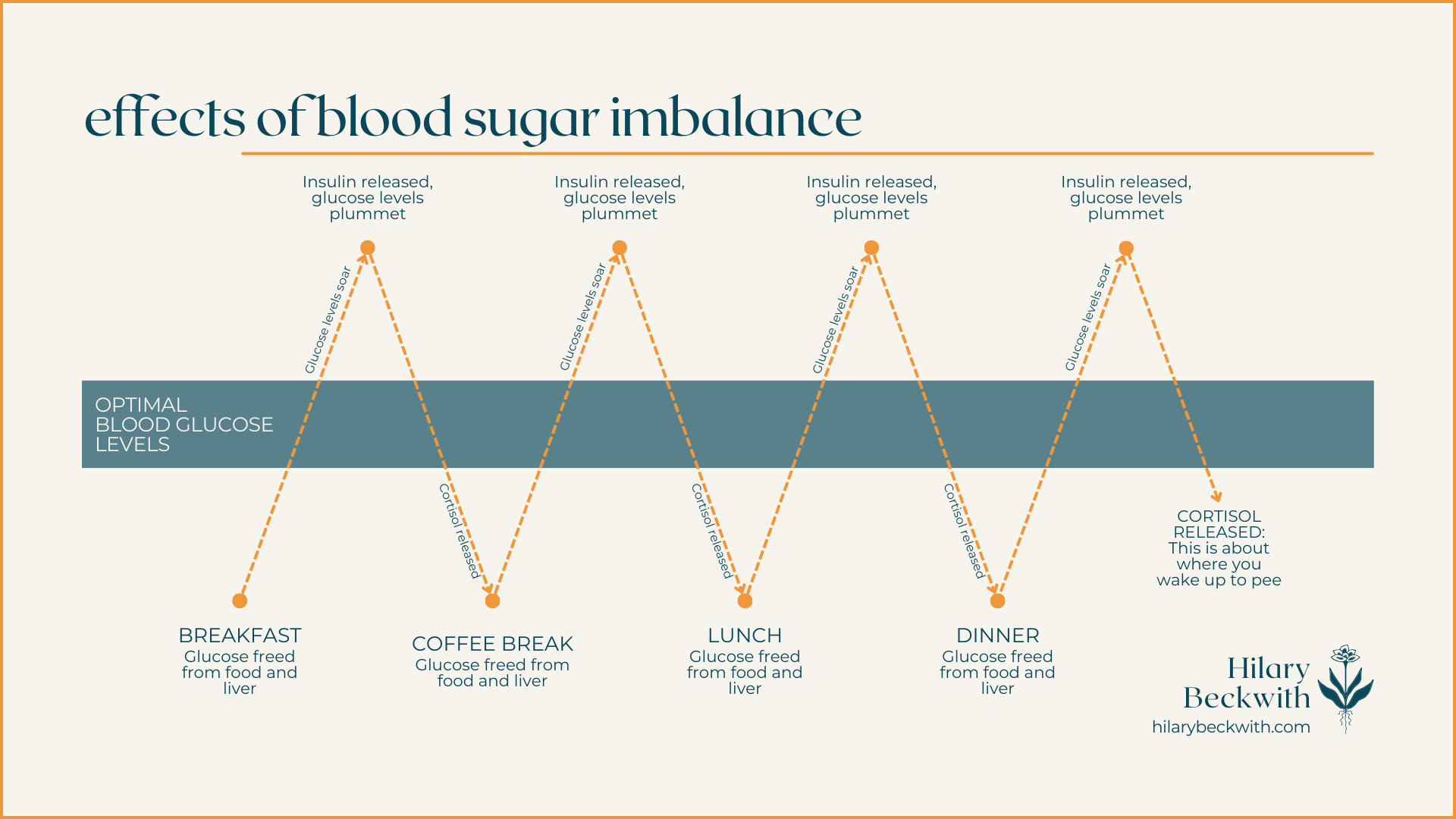
If you are the person who relies on coffee first thing to get you going, and then snack or graze all day long until you finally eat a real meal at dinner time - take a look at the diagram below:
what does this have to do with hormone balance?
Like most hormones, your body doesn’t just make cortisol out of nothing. It has to use resources like nutrients and enzymes. Cortisol is produced through an enzyme pathway from a precursor hormone called pregnenolone (there will not be a quiz).
Pregnenolone, derived from cholesterol, is also used in the same enzyme pathway within the adrenal glands to produce estrogen, progesterone, and testosterone.
You might be wondering - But aren’t sex hormones produced by the ovaries in females?
The answer is yes - but also in the adrenal glands.
As we age, the ovaries produce less and less estrogen and progesterone, but our bodies still require those hormones to maintain tissue growth, bone health, and brain health. When the ovaries stop producing sex hormones, the adrenal glands pick up the slack.
This is why it is essential to women’s health that we educate ourselves on the impact of stress on hormone balance - and why I do the work I do. Does that mean you need to shop for cortisol reduction supplements or find the best cortisol detox tips?
Let’s explore it a bit.
HERE’S WHERE THINGS CAN GO WRONG:
Because they use the same production pathway, pregnenolone can convert into sex hormones OR cortisol - butnot both. And while the fight or flight system is activated, your body will prioritize the production of cortisol over sex hormones.
If your fight or flight system is chronically activated - whether it’s due to blood sugar imbalances, external stressors, emotional stressors, or pathogenic infection - you are going to struggle with insomnia and hormone imbalances like PMOS (formerly known as PCOS).
But there is hope.
what is a cortisol detox?
As a practitioner who specializes in adrenal health and PCOS/PMOS, I can tell you that a cortisol detox is just a trendy term that wellness influencers use to talk about lifestyle shifts and dietary supports for cortisol reduction and stress.
In other words - there is no such thing as a cortisol detox.
I’m about to share with you my secrets to amazing, restful sleep, steady energy that lasts all day, and predictable periods. But why should you listen to me over influencer reels or ChatGPT?
I AM A HEALTHCARE PRACTITIONER, NOT AN INFLUENCER.
First and foremost, I am educated and trained to help clients address hormone imbalances like PCOS/PMOS and perimenopause symptoms, gut health, sleep issues, and insulin resistance by uncovering root causes of dysfunction that are specific to your body’s unique health needs.
What I’m about to share is not meant to be a temporary biohack or some magical fix to make all your stress go away.
I’m about to share meaningful lifestyle shifts you can make that are grounded in science and address your hormone imbalances at the root cause.
You don’t need a cortisol detox or some one-size-fits-all cortisol reduction supplement pack - you need real lifestyle support. And I can help.
5 holistic tips to reduce cortisol levels long-term
As we discussed earlier, cortisol output disrupts sex hormone production and is especially problematic for women and females with PCOS/PMOS symptoms, perimenopause symptoms, and other hormone imbalances.
Chronic cortisol output can also lead to insulin resistance issues, blood sugar imbalances, sugar cravings, and insomnia. In fact, the reason you wake up at 2:00am has nothing to do with your bladder - it’s cortisol.
Practicing these techniques on a consistent basis will improve sleep quality, improve insulin sensitivity and blood sugar levels, and improve hormone balance. For more in-depth and personalized support for your adrenal and hormone health, check out this masterclass.
As with any foundational root-cause work, results will not happen overnight. It takes time to really begin to notice a change in your energy levels, restfulness, and hormone balance. Be patient and kind to yourself, and reach out to me if you have any questions.
5 holistic tips to reduce cortisol
GET 10+ MINUTES OF DAYLIGHT ON YOUR FACE WITHIN 1 HOUR OF WAKING: I’m not suggesting you look directly into the sun (please don’t). When your face and eyes are exposed to light, information about the type of light gets picked up by the retina and is relayed to the suprachiasmatic nuclei (SCN), which then modulates serotonin and melatonin production, respectively, depending on the type of light you are exposed to. This simple action impacts everything downstream throughout your day. Don’t skip it.
EAT MORE SATIATING MEALS: The diagram above (titled, effects of blood sugar imbalance) shows the effects of diet on blood sugar regulation, and as you recall from earlier in the post, cortisol is released in times of low blood sugar. Eating more satiating meals, balanced with good quality protein, fat, and fibrous vegetables, prevents those dips in blood sugar and keeps you feeling steadily energetic all day. Use this guide to help you build more satiating meals.
SCHEDULE WORKOUTS BEFORE LUNCH: Remember the diagram above, titled optimal cortisol levels throughout the day? An important part of supporting healthy cortisol rhythms is to prioritize higher cortisol activities in the morning, and lower cortisol activities in the afternoon/evening. Exercise is known as a good stressor, also called eustress. However, as we’ve learned - stress is stress. Exercise stimulates cortisol output. When you exercise in the evenings, you stimulate cortisol right when cortisol levels should be coming down. Save your calmer activities like meditation, light yoga, or walking, for the afternoon and evening.
PRACTICE NOT SNACKING BETWEEN MEALS: Let’s be clear - if your body is telling you it needs to eat, eat. Always listen to your body. Remember, it will take time to see symptoms dissipate. But if you are habitually a snacker or grazer, you may have insulin resistance issues and thus, chronic cortisol output. Additionally, habitual snacking may be a sign of sugar cravings caused by pathogenic infections like candida or SIBO. Click here to read more about these pathogens. Eating more satiating meals will help you feel fuller for longer periods, reducing the need for snacking.
PRACTICE COMPLETING THE STRESS RESPONSE CYCLE: Do this 2-3 times per day, and especially immediately following a particularly stressful episode, such as a heated conversation with your partner, a stressful commute, or a nearly-missed work deadline. Why should you do this? When your fight-or-flight system is activated, stress hormones like cortisol and adrenaline are released, shifting resources away from digestion and repair and toward survival. Your nervous system can’t tell the difference between a real threat and modern stress, so it reacts to both the same way. Completing the stress response cycle only takes a few minutes and signals to your brain that the danger has passed and it’s safe to stand down. Here’s how to complete the stress response cycle:
Choose a full-body movement that feels safe to do for 3-5 minutes, such as:
jumping jacks
nitric oxide dump
air-punching/kickboxing
brisk walk while doing windmill arms
dance party
Once your movement is finished, take 10 long, deep breaths, in through your nose, and out through your mouth before continuing with your next tasks.