

Is Caffeine Bad For You? The Effects of Caffeine on Health, Fitness, and Digestion
For decades, caffeine has been marked as a villain.
But more recent information has shed light on the true effects of caffeine on health, and we’re finding it’s not as bad as we once thought. In fact, there was never a lot of evidence to support that it WAS bad.
So, is caffeine bad for you? Is caffeine good for you?
The answer:
It depends.

Is Caffeine Bad For You?
For decades, caffeine has been marked as a villain.
But more recent information has shed light on the true effects of caffeine on health, and we’re finding it’s not as bad as we once thought. In fact, there was never a lot of evidence to support that it WAS bad.
So, is caffeine bad for you? Is caffeine good for you?
The answer:
It depends.
I know, I know… I’m sorry.
But I will not leave it there.
I’m here to help you figure it out, so hang in there.
The reality is, the health effects of caffeine (we will be looking at coffee, as well), vary from person to person, depending on their biochemical makeup.
I’m going to walk you through the research and help you make the decision for yourself, whether or not caffeine is a healthy choice for your bod.
Let’s dig into it.

health effects of caffeine
Many people I know think of coffee when they think of caffeine. Caffeine is also in sodas, energy drinks, supplements, and some medications.
It’s safe to say we generally think of caffeine as a “pick me up”, right? A tool to help you feel more energized, more awake.
And that’s generally what it does.
But the specific mechanisms and chemical effects of caffeine go a bit deeper than that.
In order to help you decide whether caffeine is a healthy addition to your routine, it’s a good idea to understand these components better.
caffeine 101
HOW DOES CAFFEINE WORK?
Our brains produce a neurotransmitter called adenosine, which is released after stress or trauma, in order to restore tissues. It also has the ability to make us feel tired, because the restoration of these tissues increases our need for sleep.
So, we tend to have more adenosine in our system at the end of a long (and stressful) day, and some still remains when we wake up, making it a little hard to get going in the mornings.
Caffeine works by blocking adenosine receptors, and releasing cortisol and adrenaline, causing us to feel more awake (and also jittery) for a time.
But that’s not all caffeine does. Take a look.
OTHER HEALTH EFFECTS OF CAFFEINE
Caffeine promotes calcium release into the blood. Calcium causes muscle contraction, or excitation, whereas adenosine regulates blood flow and cardiac rhythm.
Knowing that caffeine consumption is generally associated with temporarily increased heart rate and blood pressure, this component makes a lot of sense.
This increase in muscle contraction could also explain the increase in rectosigmoid motor activity (movement of colon muscles), which is why coffee often triggers a bowel movement shortly after consuming.
Caffeine inhibits creatine uptake into cells. If you’re keen on the fitness world, you may have heard that creatine is a precursor to Adenosine TriPhosphate, or ATP, which is the energy our cells create in order to function. (Oddly enough, Adenosine is not a direct precursor to ATP)
So while it gives you a temporary boost of “awake,” consuming caffeine long term will inhibit your body’s ability to make energy.
Caffeine inhibits Nitric Oxide release into blood vessels. Nitric Oxide, or NO, is stored in blood vessels, and is released to increase blood flow by way of vasodilation (widening of the blood vessels), in order to transport more nutrients and oxygen to peripheral tissues.
One common scenario for NO release, would be any type of workout. Exercise requires the increased use of oxygen and nutrients, and therefore uses NO to help transport those components to the tissues that need it most during your workout (heart, lungs, or any muscle group you are targeting).
Caffeine increases fat oxidation during exercise (burns fat).
Caffeine temporarily increases Blood Pressure & heart rate, and yet daily coffee drinkers have lower instances of hypertension (high blood pressure) and heart attack.
Caffeine triggers the release of cholecystokinin, a hormone that stimulates the release of bile into the digestive tract. Bile is necessary to digest fats, and to remove toxins from the body.
Caffeine increases dopamine and serotonin levels.
Caffeine interferes with GABA receptors. GABA is a neurotransmitter, known to calm the adrenals after a stress response. GABA and melatonin are released more heavily in the evening time to help us relax and get more restful sleep.
How much caffeine is in coffee?
Caffeine in supplements, sodas, & energy drinks is easy to measure, because it’s deliberately added as a dosage.
But did you know that caffeine in coffee is WIDELY varied, and greatly depends on the method of roasting and brew? It is incredibly difficult to know exactly how much caffeine is in coffee, and scientific research is FAR outdated at this point, and no new studies have been published in the last couple of decades.
The good news is, my friends over at Golden Ratio did a little testing of their own, and it’s super interesting. Check it out!
health benefits of coffee
Coffee, whether caffeinated or not, can also have some impact on health, so I think it’s worth it to also look at those factors.
EFFECTS OF DRINKING COFFEE:
Stimulates the release of digestive enzymes and stomach acid.
Contains tryptophan. Tryptophan is an amino acid, the smallest form of protein, and is the precursor to serotonin. Serotonin is helpful for mood, motivation, anxiety, and obsessive thoughts.
Reduces Lower Esophageal Sphincter (LES) pressure, preventing heartburn, or acid reflux. The LES is located where the esophagus (tube in the throat that takes food to the stomach) meets the stomach. It works meticulously to relax and contract at certain times to allow food into digestion, and to keep food and enzymes out of the esophagus.
Reduces inflammation. Coffee is loaded with polyphenols, compounds that have an immense antioxidant impact. Highly unstable free radicals bounce around our tissues, causing damage to other cells, and thus, tissues. Our body responds, as it should, with inflammation, trying to heal the tissues. Antioxidants stabilize the free radicals, and provide them a way out of the body, thus reducing inflammation.
Has a protective effect on liver cells and against some cancers.
Tastes amazing! (reference: my tastebuds)
so, is caffeine bad for you?
HOW IT ALL ADDS UP
So what does it all mean? How do I know whether or not caffeine is good for me?
Let’s put the pieces together.
CAFFEINE & ADENOSINE: Having an extra “pick me up” isn’t always a bad thing. But because adenosine is responsible for regulating sleep, immune function, and cardiac rhythm, it might be a good idea to not inhibit those processes, or at least to be cautious of the timing of your caffeine consumption.
Adenosine also regulates mechanisms needed for psychiatric disorders. If you suffer from anxiety, depression, or mood disorders, caffeine may not be a good idea.
Alternative “pick me up” techniques:
Hydrate: Water consumption increases blood flow, which can help you feel more energized.
Walk: Take a quick walk around the block or do a quick set of jumping jacks. Exercise, even mild exercise, releases endorphins and provides a lift in your spirits.
B-Vitamins: There are many components of energy production, but B-vitamins are a huge factor, and many people do not get enough in their food. You can purchase my favorite B-Vitamin supplement here.
CAFFEINE & CORTISOL (and Fat Burning): Based on research referenced earlier, we now know that a strong dose of caffeine about 30 minutes prior to a workout will increase fat burning. However, cortisol also triggers the release of glucose in the blood from storage forms.
Why does that matter? Because if glucose is present, your body will prioritize glucose over fat, for energy production.
This is not inherently a bad thing, but it should be carefully considered. And if fat burning is your main goal, consider using proper intermittent fasting techniques with your workouts, or adding a l-carnitine supplement to your routine, to enhance the use of fats for energy production.
CAFFEINE & NITRIC OXIDE: NO is known to increase workout endurance and muscle power, due to its effect on oxygen distribution to peripheral tissues.
Not only does caffeine inhibit NO, but caffeine in itself is a vasoconstrictor, meaning, it temporarily narrows blood vessels, increasing blood pressure, and decreasing flow.
If you are looking to build a lot of muscle, or are training for endurance, caffeine is going to inhibit your training.
Instead, to support NO production, consider an l-arginine supplement, or my favorite Nitric Oxide supplement, called Neo40 Professional. Both can be purchased here.
COFFEE/CAFFEINE & STOMACH ACID/GUT MOTILITY: You’d be surprised how many of my clients struggle to produce enough stomach acid and digestive enzymes. So a little support with coffee ain’t always a bad thing. CLICK HERE TO READ MORE ABOUT THE EFFECTS OF DRINKING COFFEE ON AN EMPTY STOMACH
However, it’s important to recognize that many people consume coffee first thing in the morning, on an empty stomach (yep, I’m talking to you…). The stimulation of hydrochloric acid (the same stuff Dahmer used to dissolve body parts…) & digestive enzymes into an empty stomach… well, I probably don’t have to tell you what that could look like (helloooo, painful ulcers!).
If you simply MUST have coffee without food in the morning:
For one, I am curious to know why you are not hungry in the morning. While it might seem normal for you, it’s not a normal body function, and we can look into that together through my Reclaim Your Health program.
Second, remember the Bulletproof coffee craze? Well, turns out this technique is really helpful for folks who refer to coffee as “breakfast.”
If you are drinking coffee on an empty stomach, protect your gut from painful ulcers (among other digestive issues) by adding grass-fed butter, unrefined coconut oil, or even better, MCT oil. These types of fats have little effect on your blood sugar but give your stomach acid something to break down (other than the lining of your gut).
what are your thoughts?
Is caffeine bad for you, really? Is it healthy to consume caffeine?
Tell me how you put the pieces together, and how you use caffeine (or avoid it!) in your routine.
Share your experience & thoughts in the comments below.

NUTRITION SERVICES
MORE RESOURCES


Hydration Pack and Hydration IV - How Much Water Should I Drink?
You've heard it a thousand times: drink more water. But that begs the question, “how much water should I drink?”.
It's been pounded into your brain through health blogs and fitness influencers, and you do it!
You drink TONS of water.
And that feels good, right? (Well, except for all the bathroom trips)
After all, it can be difficult to create new healthy habits, so drinking more water seems like a super simple & easy way to improve our health.
But what if simply drinking more water isn't really what's helping us?

I love fall. Like, LOVE, love.
And not because of pumpkin spice everything, or comfy flannels & boots, or the excuse to constantly sip a warm beverage (although I love most of those things!).
I love fall because it's a time to shed what's old, what's damaged, what's no longer serving us, in order to make room for new growth.
We often hear Spring referred to as the time for new growth, but no one talks about what has to occur to make room for that growth - (enter: FALL!)
Don't get me wrong, I live for the cooler weather and the crisp air (and the warm beverages!).
But anyone who knows me knows I am a huge advocate for getting rid of what is no longer serving you. Not covering it up, not adding to it. But throw that sh*t in a pile and light. it. up!
What does that have to do with hydration? Wondering how much water should I drink? Looking for hydration packs and hydration IV support?
Let's talk about it.

You've heard it a thousand times: drink more water. But that begs the question, “how much water should I drink?”.
It's been pounded into your brain through health blogs and fitness influencers, and you do it!
You drink TONS of water.
And that feels good, right? (Well, except for all the bathroom trips)
After all, it can be difficult to create new healthy habits, so drinking more water seems like a super simple & easy way to improve our health.
But what if simply drinking more water isn't really what's helping us?
What if all those extra trips to the bathroom are all for naught?
This healthy habit may not be serving you the way it once was. It may be time to reevaluate this habit, and make room for something better, more effective.
To make room for new growth.
Are hydration packs the answer? Is a hydration IV the key to better hydration?
In honor of our dear friend, Fall, let's toss out that old idea that drinking more water will make you healthier. Let's make room for a new, better lifestyle change - hydration!
how much water should I drink?
What is hydration?
When we talk about hydration, it's best to think of it as cellular hydration. Proper balance of fluid between the insides of your cells (intracellular fluid, or ICF) and the outside of your cells (extracellular fluid, or ECF) is necessary for many body functions:
influences volume of blood
elimination of waste
blood pressure regulation
influences flow of bile
transfer of nutrients across cell membranes
proper nerve impulses
influences lymphatic flow (think, immune system and drainage of excess fluid)
provides "cushion" of protection around organs, and joints
So, does simply drinking water hydrate our cells?
Not really.
Drinking lots of water, without considering the necessary components to actually hydrate your tissues, will quite literally just go in one end, and out the other.
There's a little more to it than that, but in the end, the fix is still pretty simple (more on that later).
Here's where I get a little science-y, but stick with me...
In order for proper fluid balance to occur, osmosis needs to occur. Fluid can flow freely (does not need special transport channels) across the cell membrane, but it will only do so using osmotic force, meaning the fluid will only flow in order to equalize the concentration of solute particles (electrolytes) in the fluid (known as osmolarity).
Put more simply, your body will redistribute fluid as needed in order to maintain osmotic balance, even if that means taking fluid from areas that need it. It will move fluid from places of lower electrolyte concentration, to places of higher concentration.
Your kidneys are pivotal to this process. They are responsible for eliminating excess fluid and electrolytes and retaining them when necessary.
Here is a great example of this that you are more familiar with:
Typically speaking, potassium (one type of electrolyte) likes to hang out in the fluid inside of cells, while sodium (another electrolyte) likes to hang in the fluid outside of cells. When a diet is high in sodium, and low in potassium, the cells get dehydrated and shrivel, because the concentration of electrolytes in the ECF is greater than the concentration in the ICF.
This leads to an excess of fluid in the ECF (remember this stands for extracellular fluid), ie. edema. So if you know someone whose ankles regularly swell, and their doctor has told them to eat less salt, this is why, friends.
But salt (or sodium, rather) is not the only culprit here, so let's not get stuck on that. Lots of things impact this fluid balance and thus impact hydration. This is where hydration packs and hydration IVs might be of support.
Let's take a look at the factors of dehydration:
dehydration factors
caffeine + alcohol: Both of these things are considered to be toxins by our liver. When they are ingested, the liver prioritizes their elimination above most other liver functions. In order for the liver to process anything for elimination, blood needs to be able to effectively flow through the liver. Consuming too much caffeine and/or alcohol without properly hydrating, will inhibit the liver's ability to remove them from your body.
high sodium diet/low potassium diet: as we discussed earlier, these two electrolytes strongly influence the balance of ICF to ECF. Typically speaking, a high sodium diet naturally IS low in potassium, but it's not mutually exclusive. Remember, sodium is not the villain - it is necessary for many functions, but we need to be careful to balance.
sweat: Sweat is an important part of our body's ability to eliminate toxins and cool our bodies when they are too warm. But, when we sweat we also eliminate electrolytes, which, as we said, are important to the fluid balance of the body. It's perfectly fine (and in fact, important!) to sweat a LOT, but only if you are careful to replace fluid and electrolytes that are lost.
diarrhea + vomiting: Okay, these can't always be helped, right? But they are significant causes of fluid loss. If there are foods that you know your body is reactive to in these ways, don't consume them. Period. And if you do find yourself kneeling at the throne, be sure to replace those fluids and electrolytes that get flushed (more on how to do that later in the post).
So, what's the fix?
This is what you came for, my little muffin top.
Here are 4 ways to get hydrated, & stay hydrated:
Drink more water (duh!) - Unless you have kidney dysfunction, or are on certain medications, most people need to drink at least half of their body weight, in fluid ounces of water, every day.
Eat (lots of) mineral-rich foods - Eating a wide variety of locally seasonal foods is the best way to get all of the nutrition you need to support your body. But minerals, specifically, are found abundantly in foods like whole, sprouted grains, legumes, dark leafy greens, avocados, and seeds.
Move your lymph - Lymph is important to moving excess fluid out of the body, and there are lots of ways to get it moving regularly. Drinking enough water is the first, but also dry brushing, trampoline jumping, & deep breathing are all effective at moving lymph.
Take an electrolyte supplement - If you've been with me for any amount of time, you know that you cannot supplement your way out of a poor lifestyle (read that again). But for those who need a little extra temporary support (such as those who cannot digest mineral-rich foods well, don't have access to those foods, or are currently deficient in electrolytes), this electrolyte supplement is my favorite.
was this helpful?
How do you stay hydrated? Share your thoughts in the comments below!
NUTRITION SERVICES
MORE RESOURCES
Clean Eating 101
How your food is grown and processed, and where it comes from, are the biggest factors in determining what makes a food a "healthy food."
Some important questions to ask yourself when determining the quality of your foods are:
Is it organic?
Does that even matter?
Is it heavily broken down before it's added as an ingredient?
Was it grown and harvested in a way that is sustainable to the environment, and that does not put extra toxins into your body?
What other ingredients are in the food?

Healthy Eating Online Nutrition Course
Have you ever been at the grocery store, and tossed foods into your cart because they 'sound' healthy?
Or have you ever restricted your diet to avoid a certain food or nutrient, because you heard somewhere that it's bad for you?
(uh, hello, are you in my HEAD?!)
If you think I've been stalking you, it's because I've been there, too!
I've tried all the diets, I've bought foods because they sound healthy, I've played the guessing game, over and over... and I wasted a lot of time and money doing it…
...until I began to learn more about what really matters in regard to health.
Let's face it - healthy eating is confusing!
We all want to be healthier.
We get caught up in the myths:
healthy equals skinny
healthy equals strength & cardio training 5 days a week
healthy equals salads every meal
healthy equals foods that don't taste good
healthy equals having the energy to do ALL the things, ALL the time
But the truth is, we've been fooled.
the dirty truth about healthy eating
We've been fooled by the Dr. Phils and the marketing experts at Kraft, into thinking our foods have to say "gluten-free," "vegan," “all natural,” or "heart healthy" in order to be good for our bodies.
We are confused and ultimately misinformed by people we trust to have the answers.
And the reality is, we don't have the time (or even know where to begin) to do the research ourselves, so we just have to trust!
Well, lucky for you, friend, I have done the research.
I am a nutrition expert, and I'm here to help you dig your way out of that confusion.
I'm here to help you know how to decide for yourself what is best for your health, and your family's health.
3 PILLARS OF HEALTHY FOOD CHOICES:
bio-individuality
quality of ingredients
"good, better, best" mindset
BIO-INDIVIDUALITY:I see you scratching your head, don't worry. Bio-individuality is short for "biological individuality," meaning, what biological factors in your own body determine how well you can digest foods, absorb their nutrients, and eliminate waste. For example, we can't truthfully say "gluten is bad" for everyone, without knowing how their body processes gluten.
QUALITY OF INGREDIENTS: How your food is grown and processed, and where it comes from, are the biggest factors in determining what makes a food a "healthy food."
Some important questions to ask yourself when determining the quality of your foods, are:
Is it organic?
Does that even matter?
Is it heavily broken down before it's added as an ingredient?
Was it grown and harvested in a way that is sustainable to the environment, and that does not put extra toxins into your body?
What other ingredients are in the food?
GOOD, BETTER, BEST: This is a technique I teach my clients and live by in my own life. It is unfortunate (who am I kidding, it's actually maddening!) that quality, healthy foods are not accessible to every one, in every geographical location, and in every income bracket.
It is upsetting to me that we call foods that are heavily processed and filled with toxins, "conventional," consequently labeling quality foods as novelty items (and pricing them accordingly).
But the reality is, you have to do what is best for you, and especially if you have a family to consider.
When choosing foods, you need to consider:
availability
cost
moral considerations
community support
food allergies
picky eaters
religious considerations
(if there are any I missed, please add them to the comments!)
So, when it comes down to it, I can tell you what is "best," but you have to decide if it's what is sustainable for you. That's why I teach and advocate for the "good, better, best" mindset.
Okay, so how do I actually know how to choose healthy foods?
label-reading 101
Since I cannot assess your Bio-Individual needs through a blog post (wouldn't that be cool?! Or maybe creepy... never mind...), let's look at food quality.
In the past, humans have not led such on-the-go lifestyles. We used to grow or forage our own food, eat seasonally, make our own flours, can our own vegetables & fruits, etc..
I do not need to tell you, we are no longer living that life.
What that has caused is the need for foods to become more shelf-stable. As food sensitivities increased due to stressed eating and poor gut health (and misinformation about what is "healthy" and not healthy), so have additives and fillers increased in our foods, to mimic textures of the real thing. Let's not forget the MONEY! Food manufacturers use techniques to increase profits, like using highly toxic (but deemed "safe") forms of fats and sugars to make their foods, rather than non-toxic forms.
It's easy to point to the reality that eating organic, fresh, whole foods is what's best for us (and it is). BUT... that's not what our lifestyles typically support.
This is why we need to learn to look at food labels to determine if what we're eating is healthy or not.
I'm not referring to "front-of-box" labeling - you've already been fooled by that, which is why you're here!
And I'm not talking about the "Nutrition Facts." Counting calories is not a form of healthy eating, and I do not advocate for it in most cases.
I'm talking about the ingredients list.
TIPS TO HELP YOU CHOOSE HEALTHY FOODS:
look for foods in their most whole form - avoid terms like "concentrate," "modified," or "hydrolyzed." These terms typically indicate the ingredient has been heavily processed, which often entails toxic methods.
avoid toxic oils & fats - the myth that eating "low fat" is healthiest, has been long debunked, but what we have to look for now, are fats that are heavily processed and toxic to our bodies. Remember, toxins prefer fat, so the quality of fats you take in is very important. Looks for oils and fats that are the "extra virgin," "expeller pressed," or "unrefined." Avoid (always): Canola, vegetable, rapeseed, safflower, and sunflower oils.
certified organic - This is a gray area. The term "organic" on a food label, is only as good as the entity that certified it as "organic." In other words, the standards of organic are different for each organic certifier. According to the USDA, organic means it contains no GMOs, & no synthetic pesticides were used.
A food can be labeled organic without actually having been regulated by anyone, and the opposite is true as well (a food may not be labeled organic, even though it follows organic standards).
Your best bet - get to know your farmers.

whole grain - Eating grains in their whole form is crucial to ensuring we get important nutrients, and reducing our inflammatory response. In the US, the term "whole grain" means that the product has to consist of at least 50% whole grains. But it's important to look at what the remaining 50% consists of. If you're eating "whole grain" bread, that also contains sugars, rice flour, and potato starch... you see where I'm going with this...
preservatives, emulsifiers, and chemicals - There are a lot of foods and products that are labeled as being "pet safe," or "kid safe," but it does not necessarily mean they are things we should be putting into (or on) our bodies.
The list of what to avoid is far too extensive for this little article, but in short, it's best to avoid:
ingredients with more than 4 syllables
ingredients with all CAPS
ingredients ending in a-t-e
ingredients you cant pronounce, or have never heard of
ingredients associated with a number
ingredients preceded by "enriched"
Feeling a bit better about your future shopping trips?
I love talking about this stuff because it consistently comes up in conversations, that we are all so confused about what it takes to be healthy.
It's exactly why I developed Cut the Crap (formerly Kitchen Detox Workshop).
Cut the Crap is worth its weight in gold, friend. We scratched the surface in this article, but the workshop dives deeper into those factors, plus a few others. It also gives you hands-on tools to help you inventory your own kitchen, and stock your kitchen with only quality, wholesome foods.
Put differently, Cut the Crap helps you to make healthy food choices, every single time you eat.
Ditch the guilt of eating "bad" foods.
Stop playing the guessing game at the supermarket.
Stop wasting money on fruitless health hacks.
Make healthy choices that really matter.
Click the button below to learn more about Cut the Crap, my online label-reading course to help you spot health scams and make healthy food choices more confidently.
NUTRITION SERVICES
MORE RESOURCES

Make Cold Brew Coffee At Home (you will never go back!)
As a nutritionist, I can tell you that your craving for afternoon coffee has everything to do with adrenal dysfunction or blood sugar…
But I’m not going to get into that today, because the reality is, on a warm summer day in Seattle, there is nothing better than sipping a super smooth, rich, icy cup of cold brew coffee.
Cold brew coffee is stupid easy to make in any case, but this method blows all others out of the water.

Cold-Brew Coffee Recipe
I’m going to get straight to the point here.
I. Love. Coffee.
As a nutritionist, I can tell you that your craving for afternoon coffee has everything to do with adrenal dysfunction or blood sugar…
But I’m not going to get into that today, because the reality is, on a warm summer day in Seattle, there is nothing better than sipping a super smooth, rich, icy cup of cold brew coffee.
Cold brew coffee is stupid easy to make in any case, but this method blows all others out of the water.
Concerned about caffeine? Here’s a great resource for you.
Let’s get to it.
cold Brew coffee concentrate
WHAT YOU NEED
9oz. coffee beans (choose your favorite roast), ground course
3.5 cups (28oz.) filtered water, room temperature
2-quart French press, or 2-quart measuring cup
Cheese cloth, old (clean) T-shirt, or nut-milk bag (skip this if using a French press)
Himalayan or Celtic Sea salt (optional)
INSTRUCTIONS
In the French press or measuring cup, place the ground coffee beans. Gently add the filtered water, ensuring all grounds are immersed, let sit for 10 minutes.
Gently stir the grounds to re-wet them. Cover and let sit at room temperature for 24 hours.
If using a French press, press and pour into a glass container with a tight-fitting lid. If not using a French press, filter through cheese cloth, T-shirt, or nut milk bag, and store in a glass container with a tight-fitting lid.
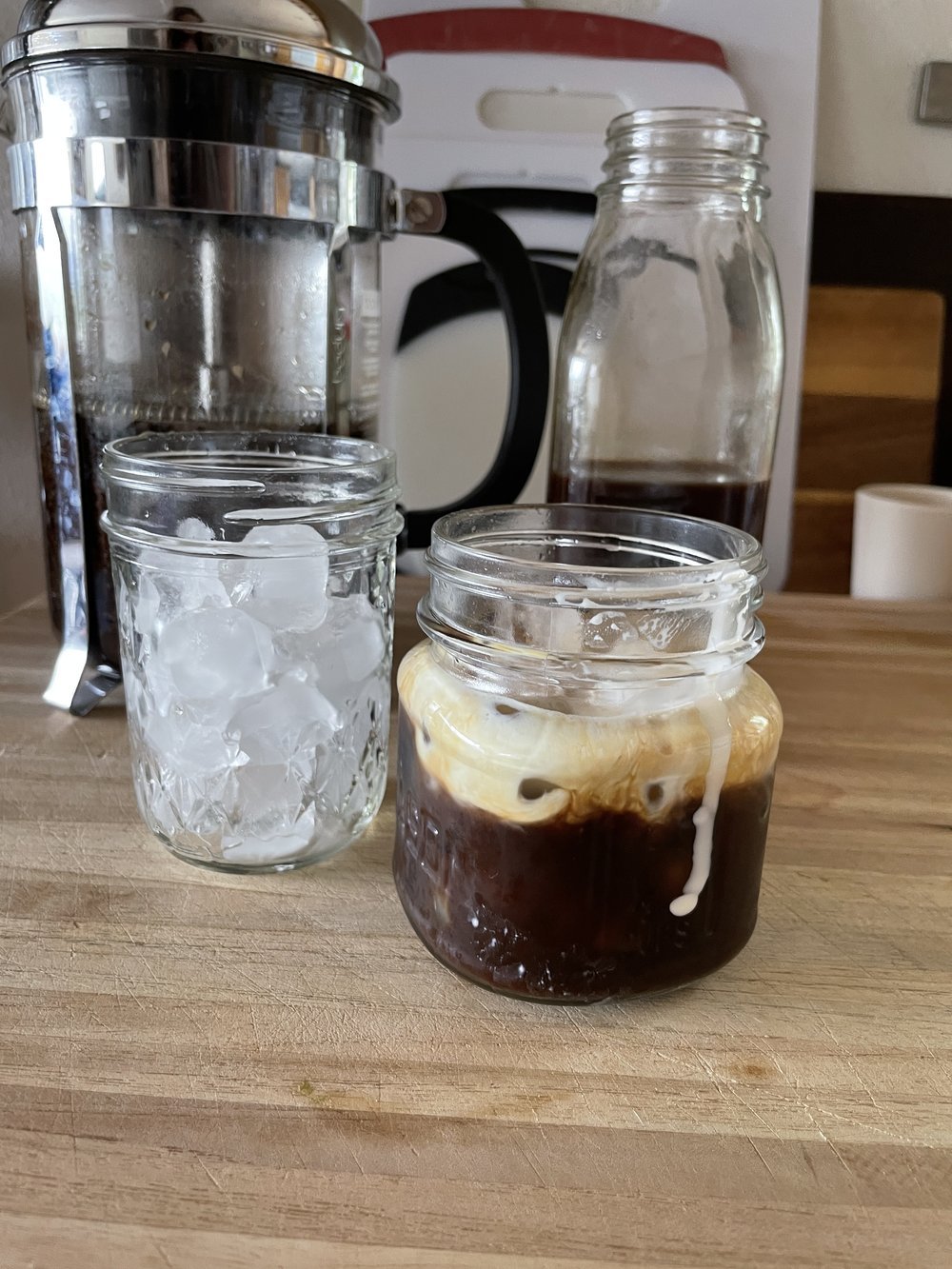
To serve, dilute 1:1, water to concentrate (or pour over ice). Add cream or sugar, if that's how you dig it, and enjoy pure bliss!
This concentrate can be stored in the refrigerator for up to 7 days.
did you make this recipe?
Share your experience in the comments!
NUTRITION SERVICES
MORE RESOURCES

Easy Weeknight Recipe: Mediterranean Superfood Bowl
This recipe is my favorite in terms of versatility and nutrient density. It’s the perfect healthy recipe for easy summer evenings.
The ingredients can be switched up easily without risking flavor components and can easily adapt to your nutritional needs. The romesco is plant-based on its own, so there’s no need to adapt if you eat vegan.

Easy Healthy Vegan Recipe
This recipe is my favorite in terms of versatility and nutrient density. It’s the perfect healthy recipe for easy summer evenings.
The ingredients can be switched up easily without risking flavor components and can easily adapt to your nutritional needs. The romesco is plant-based on its own, so there’s no need to adapt if you eat vegan.
While the fresh vegetable component does not make this a freezer-friendly meal, the sauce does freeze well. In fact, we eat these often in my home, so I typically will double or triple the recipe for romesco and freeze it in individual portions.
One batch of sauce, greens, & grain, makes 4 bowls. Top to your tummy’s content to make the tastiest healthy recipe!
Want to know how to choose the best quality ingredients for this recipe? This is the best resource for understanding food labels.
Let’s get to the recipe!

Mediterranean superfood bowls - plant-based and vegan-friendly
FOR THE SAUCE:
16oz JAR ROASTED RED PEPPERS (OR ROAST YOUR OWN!)
1 CLOVE GARLIC, PEELED
½ TSP SEA SALT (MORE TO TASTE)
JUICE OF 1 LEMON (ABOUT ¼ CUP)
½ CUP EXTRA VIRGIN, COLD-PRESSED OLIVE OIL
½ CUP WHOLE, RAW ALMONDS
FOR THE BOWLS:
2 CUPS LOOSELY PACKED, CHOPPED (PICK ONE):
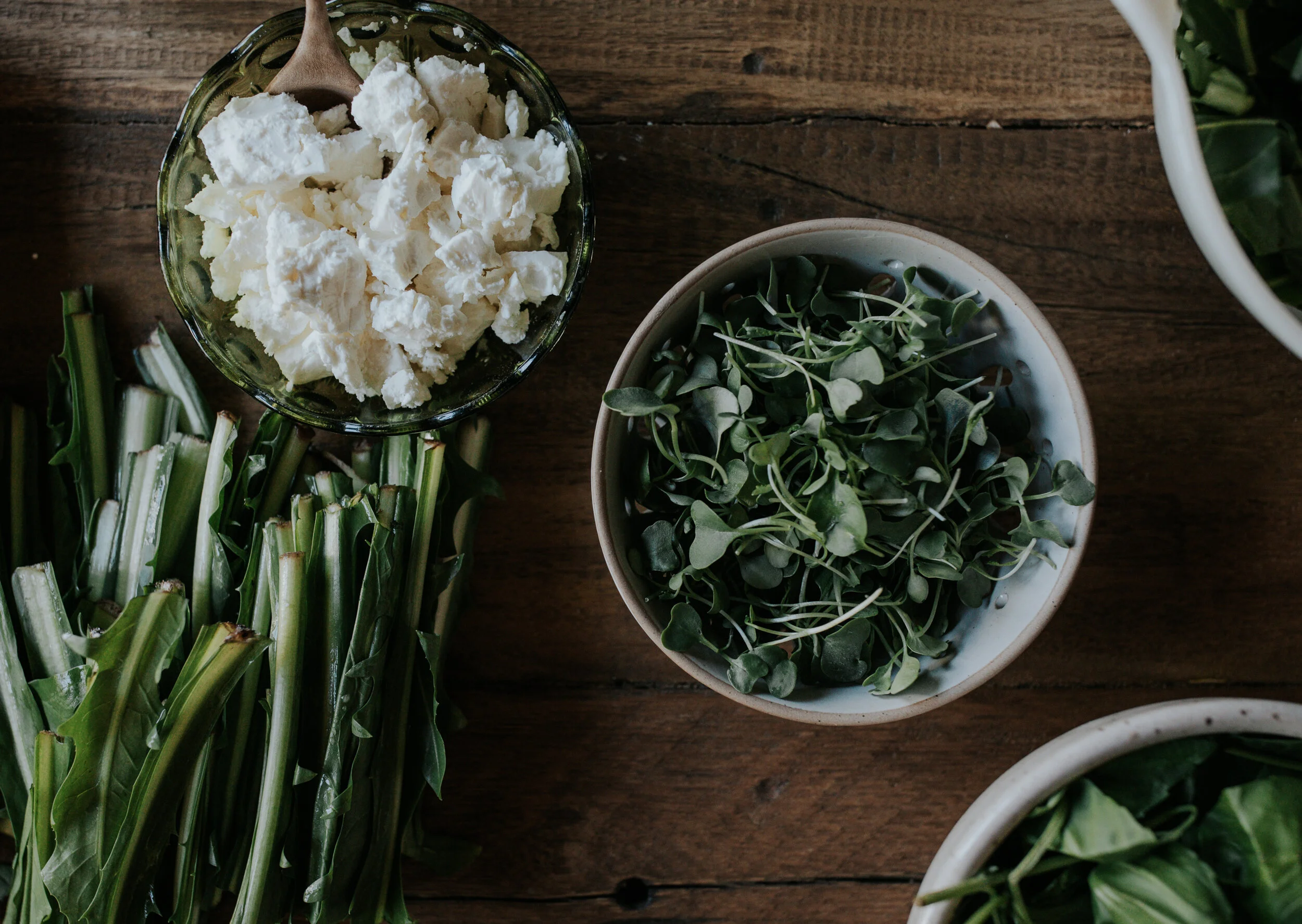
DANDELION
ARUGULA
SPINACH
BABY KALE
½ CUP UNCOOKED GRAIN (PICK ONE) (omit, if you’re grain-free):
QUINOA
WILD RICE
FARRO
PICK 1-2 FATS/PROTEINS:
OLIVES (KALAMATA, GREEN, BLACK)
RAW PUMPKIN SEEDS, LIGHTLY TOASTED
CRUMBLED FETA CHEESE
QUALITY HUMMUS (OR CHICKPEAS!)
AVOCADO
PICK 2-3 (OR 4 OR 5) HERBS/VEG/OTHER TOPPINGS:
HEIRLOOM DICED TOMATOES
DICED CUCUMBER
MICROGREENS
SLICED RADISHES
ARTICHOKE HEARTS
PEPPERONCINI
CHOPPED CAULIFLOWER
THINLY SLICED RED ONION
SLICED GREEN ONIONS
FRESH CILANTRO/ITALIAN PARSLEY/BASIL, CHOPPED
LEMON JUICE
EXTRA VIRGIN OLIVE OIL
SALT & PEPPER
SLICED JALAPEÑOS
Cook the grain you selected according to package directions (unless omitting). Allow to cool to room temperature.
Place all sauce ingredients in a blender or food processor fitted with a chopping blade. Blend/process on high speed until desired consistency (I prefer it a tad on the “chunky” side).
Prepare the greens and other toppings. There is no hard & fast rule to this – go with your favorite textures & flavors! I prefer my ingredients to be more finely chopped, giving it a “chopped salad” mouth feel, but you may enjoy a chunkier texture.
Divide the greens, grains, sauce, then your toppings, among 4 separate bowls. Enjoy right away, or store in airtight glass containers. Will last 4-5 days in the refrigerator, depending on ingredient freshness.

did you make this recipe?
How’d it go? Share your thoughts in the comments!
NUTRITION SERVICES
MORE RESOURCES